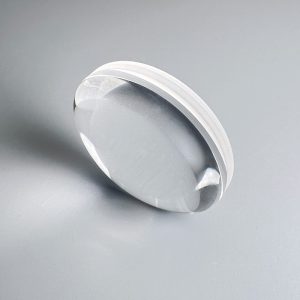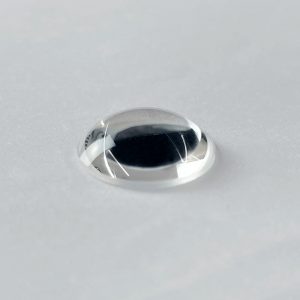
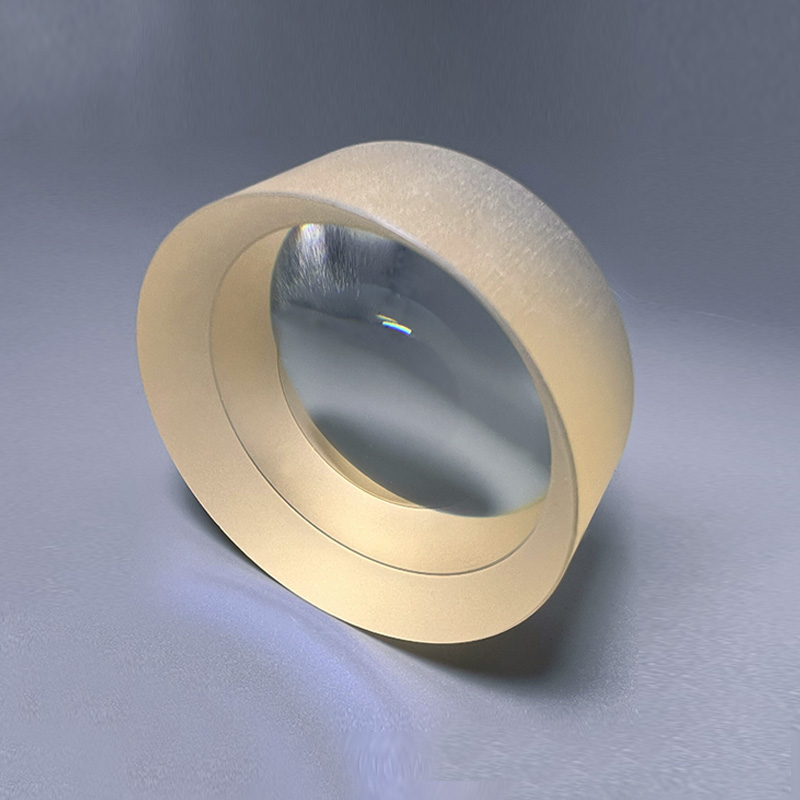
A cemented lens—also known as a compound lens—is a monolithic optical component formed by precisely aligning and bonding two or more individual lenses made from different optical materials along the optical axis using optical-grade epoxy resin. The most common configurations are doublets and triplets.
By combining optical glasses with differing refractive indices and dispersion properties—such as crown and flint glass—cemented lenses effectively correct chromatic aberration while simultaneously addressing spherical and coma aberrations. They serve as foundational building blocks for high-performance optical systems.
Core Value Advantages
Superior Chromatic Aberration Correction
Through complementary design of positive and negative lens elements made from different materials, cemented lenses significantly reduce focal separation across wavelengths, delivering enhanced image sharpness and color fidelity across the full spectrum—ideal for white-light imaging and multispectral applications.
Compact Structure and High Stability
The cementing process integrates multiple optical surfaces into a single, rigid unit—reducing assembly-induced errors and improving optical axis alignment consistency. It also eliminates air gaps, thereby avoiding associated reflection losses and contamination risks, resulting in simpler, more robust optical systems.
Enhanced Modulation Transfer Function (MTF)
Compared to singlets of equivalent focal length, cemented lenses maintain higher MTF values over larger apertures and wider fields of view—ensuring superior resolution performance critical for machine vision, microscopy, and other high-precision imaging applications.
Flexible Material and Structural Configurations
Multiple glass pairings are supported—including BK7+SF2, N-BK7+N-FK5, and others—to meet specific spectral and dispersion requirements. Various structural forms are available, such as meniscus, plano-convex/plano-concave combinations, and more.
Typical Application Areas
• Objective lenses for biological and metallurgical microscopes
• Machine vision lenses and industrial inspection systems
• Photography and security surveillance lenses
• Spectrometers and collimation systems
• Laser focusing and beam shaping (including select UV and IR bands)
| Parameter | Standard Grade | Precision Grade | High-Precision Grade |
| Wavefront Error | λ/4 @ 632.8nm | λ/6 | λ/10 |
| Centration Error | <3 arc minutes | <1.5 arc minutes | <0.5 arc minutes |
| Cemented Surface Alignment | <5μm | <3μm | <1μm |
| Adhesive Layer Uniformity | <1μm | <0.5μm | <0.2μm |
| Surface Quality | 40-20 | 20-10 | 10-5 |
| Cementing Type | Material Combination | Abbe Number Difference | Chromatic Correction Range | Applicable Spectrum |
| Achromatic | Crown + Flint | >20 | Visible | 400-700nm |
| Apochromatic | Specialized Glass Pairings | >30 | Broadband | 400-1000nm |
| UV-Optimized | Fused Silica + Calcium Fluoride | Customized | UV–Visible | 250-700nm |
| IR-Optimized | Silicon + Germanium / Zinc Selenide | Customized | Infrared | 2-14μm |